Plug-In vs Hardwired vs Battery CO Detector: What Each One Is Actually For
Carbon monoxide detectors come as plug-in, hardwired and battery units, and the format changes what happens in a power cut, where you can put them, and how likely they are to still be working in three years. The certification question matters more than the format question.
Published · Facts checked against the official product page
Key takeaways
- Format is the second question. The first is whether the device states a certification — UL 2034 in North America, EN 50291 in Europe. A life-safety device that doesn't name a standard is not a bargain at any price.
- Hardwired with battery backup is what building regulations are generally written around, and it is the only format that survives both a power cut and a dead battery.
- Plug-in units are the easiest to place badly. Outlets sit low, and while CO mixes with air rather than sinking, outlet height is decided by wiring convenience rather than by where you need to sense.
- Battery units win on placement freedom and lose on the thing that kills detectors: nobody replaces the battery, and sensors expire on a schedule people ignore.
Choosing a carbon monoxide detector looks like choosing a mounting format. It isn't, quite — the format matters, but a question underneath it matters more, and most buying guides skip straight past it.
The question that comes first
Does the device state a certification? UL 2034 in North America, EN 50291 in Europe. These standards exist because a CO detector is not a gadget that underperforms — it is a device that either alerts you or does not, in a scenario where nothing else will.
Plenty of detectors sold direct-to-consumer never name a standard. That does not prove they are uncertified; it proves the page doesn't say, on the one specification where saying is normally mandatory. Our CarbonOne Safe review works through a current example where exactly that line is missing.
Round 1: what happens when the power goes out
Hardwired with battery backup is what regulations are generally written around, and the only format that survives both a power cut and a flat battery. It also needs an electrician.
Plug-in is instant to install and depends on the outlet. With battery backup it is genuinely fine; without it, it is asleep during exactly the conditions that raise CO risk — generators, alternative heating, a house running on improvisation.
Battery is free of the grid entirely and hostage to a human remembering.
Round 2: where you can put it
Battery units win outright: anywhere. Hardwired goes where the wiring goes. Plug-in goes where the outlets are, which is a real constraint — outlets are placed for wiring convenience, not for sensing, and they cluster low and along walls.
Height matters less than people think, because CO mixes with air rather than sinking or rising. What matters is distance from the appliance and proximity to where you sleep. Propane is the exception: it is heavier than air and pools low.
Round 3: the failure nobody plans for
Not the battery. The sensor. Electrochemical CO sensors have a service life — typically five to seven years — and they expire regardless of whether the unit still powers up and passes its test button. The test button tests the horn, not the sensor.
This affects all three formats equally and it is the single most useful habit in this article: write the replacement date on the casing the day you install it. A detector that looks fine and cannot detect is worse than no detector, because it stops you buying one.
Round 4: the readout question
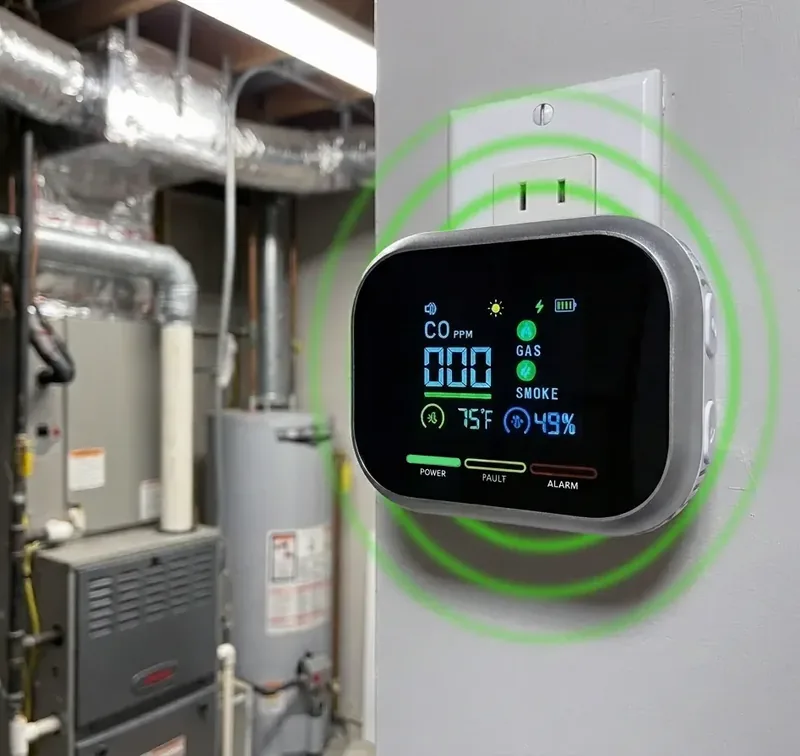
Some units show a live ppm figure rather than staying silent until an alarm threshold. That is genuinely useful information — it turns a yes/no device into something you can watch over weeks, and it is how you notice a boiler running at low double digits every morning long before anything triggers.
It is not a substitute for certification. Buy the readout as an addition to a certified alarm, not instead of one.
The answer, by situation
Choose by circumstance
- Own the property, want it right → hardwired with backup
- Renting, or want it tonight → plug-in with battery backup
- Odd room, no outlet, no wiring → battery, with a diary reminder
- Want to watch the trend → a readout unit alongside a certified alarm
Non-negotiables, whichever you pick
- A stated certification standard
- One per sleeping level, in the hallway outside bedrooms
- A few metres from fuel-burning appliances, not beside them
- The sensor expiry date written on the casing
The verdict on CarbonOne Safe
Format follows circumstance and there is no wrong answer among the three — but there is a wrong purchase, and it is an uncertified device chosen because it had the better display. Get the standard first, the format second, and the replacement date on the casing before you hang it up. The placement rules are in where to place a CO detector.
Frequently asked questions
Does it matter how high I mount a CO detector?
Less than people assume. Carbon monoxide mixes with air rather than pooling at floor or ceiling, so height matters far less than distance from the appliance and proximity to where you sleep. What does pool is propane, which is heavier than air — if propane is your concern, mount low near the source.
Is a plug-in unit good enough?
It can be, provided it is certified and it has battery backup. The reason to care about backup here is specific: power cuts are exactly when people run generators and alternative heating, which is when CO risk rises. A plug-in with no backup is blind at the worst moment.
How long do these last?
The electrochemical sensor has a service life, typically five to seven years, and it expires whether or not the device still lights up. That is the failure mode nobody plans for: a detector that looks fine, beeps on test, and can no longer detect. Write the replacement date on the casing the day you install it.
Do I need one per floor?
One per sleeping level is the usual guidance, positioned in the hallway outside bedrooms rather than inside them, plus one near — but not beside — a fuel-burning appliance. Too close to a boiler and normal start-up causes nuisance readings.
Related reading
More comparisons →
Carbon Monoxide Detector Buying Guide 2026: The Spec That Isn't Optional
One specification separates a life-safety device from a gadget with a display. Plus where to mount, what expires, and why the test button lies.
Life-Safety Devices Are Being Sold Like Gadgets. The Missing Line Is Certification.
Smoke and CO detectors now sell through the same direct-response funnels as kitchen gadgets — and the standards that define them are dropping off the page.
Where to Place a Carbon Monoxide Detector: A Room-by-Room Guide
CO detector placement, room by room: which floors need one, height on the wall, distances from appliances, and the spots that cause false alarms or missed ones.