Carbon Monoxide Detector Buying Guide 2026: The Spec That Isn't Optional
Buying a CO detector looks like choosing between plug-in, hardwired and battery. Underneath that sits one non-negotiable specification, one expiry date nobody plans for, and one test button that does not test what people think it tests.
Published · Facts checked against the official product page
Key takeaways
- A stated certification — UL 2034 in North America, EN 50291 in Europe — is the specification that separates a life-safety device from a gadget. Devices sold direct-to-consumer frequently do not name one.
- The test button tests the horn, not the sensor. Electrochemical sensors expire on a schedule of roughly five to seven years, and an expired unit still beeps when tested.
- Height matters far less than people assume, because CO mixes with air. Distance from the appliance and proximity to sleeping areas decide placement. Propane is the exception — it pools low.
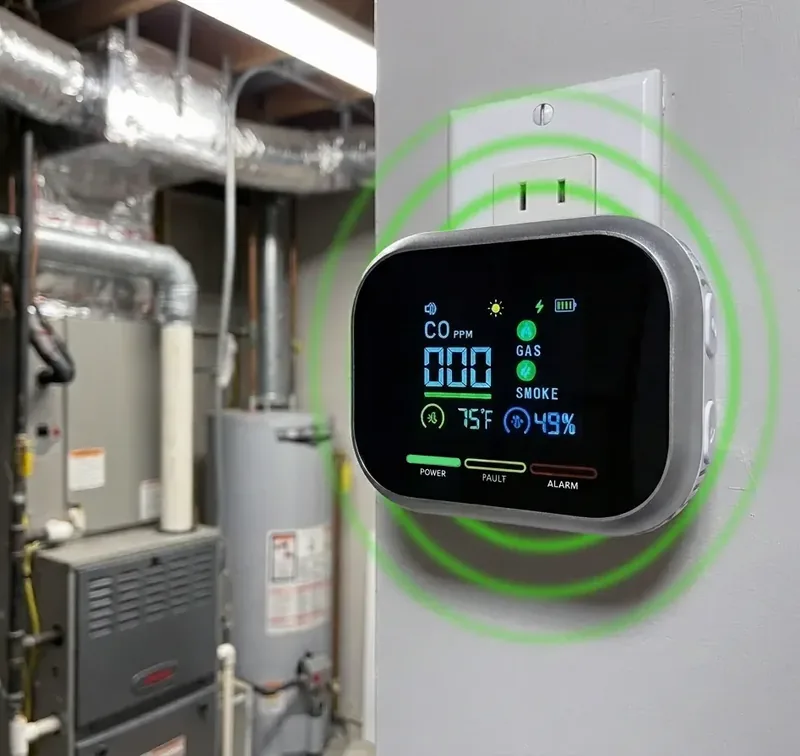
- A live ppm readout is genuinely useful and is not a substitute for certification. It turns a threshold alarm into something you can watch over weeks, which is how a slowly failing appliance gets caught.
Most guides to this category start with mounting formats. That is the second question. The first one is shorter and almost nobody asks it.
The specification that isn't optional
Does the device state a certification? UL 2034 in North America. EN 50291 in the UK and Europe.
These standards exist because a CO detector does not underperform gracefully. It either alerts you or it does not, in a situation where no other sense will help — carbon monoxide is colourless, odourless, and the early symptoms are indistinguishable from a headache and mild nausea.
Devices sold direct-to-consumer frequently name no standard at all. That does not prove a device is uncertified. It proves the page declined to say, on the specification where saying is normally mandatory — and our CarbonOne Safe review covers a current example of exactly that gap, on a unit whose live readout is otherwise a genuinely useful feature.
The expiry nobody plans for
Ask most people how a CO detector fails and they will say the battery. It is not the battery.
The electrochemical sensor has a service life — typically five to seven years — and it expires whether or not the unit powers up, lights up, or passes its test.
Which brings us to the sentence worth keeping: the test button tests the horn, not the sensor. An expired detector beeps confidently and detects nothing, and its owner feels protected. That is worse than owning no detector, because it stops you buying one.
The fix costs nothing: write the replacement date on the casing in marker the day you install it. Not on a calendar you will migrate away from — on the device, where you will see it.
Where to put them
Height matters far less than intuition suggests. Carbon monoxide has a density close to air and mixes rather than rising or sinking, so ceiling-versus-knee-height is largely a non-question.
What does matter:
One per sleeping level, in the hallway outside bedrooms. CO poisoning kills people who are asleep, which is why proximity to where you sleep outranks proximity to the appliance.
Near, not beside, fuel-burning appliances. A few metres. Too close and normal boiler or stove start-up produces nuisance readings — and nuisance readings train you to ignore the device, which is its own failure mode.
Propane is the exception. It is heavier than air and pools low. If propane is your primary concern, mount low near the source. Full placement detail is in where to place a CO detector.
Format, briefly
Hardwired with battery backup is what building regulations are generally written around and the only format that survives both a power cut and a flat battery. Needs an electrician.
Plug-in is instant and constrained by where outlets are. With battery backup it is genuinely fine; without it, it is asleep during power cuts, which is exactly when generators and alternative heating raise CO risk.
Battery goes anywhere and depends on a human remembering.
The three are compared in detail in plug-in vs hardwired vs battery.
The readout question
Some units display a live ppm figure rather than staying silent until a threshold. This is worth paying for, and for a specific reason.
A threshold alarm is designed to save your life and is useless for spotting a problem developing. A continuous reading turns a binary into a trend — you notice the boiler running at 12 ppm every morning long before anything triggers, and you get it serviced on a Tuesday instead of evacuating on a Sunday.
It is an addition to a certified alarm. Not a replacement for one.
The shortlist
Certification named on the page. Battery backup if it plugs in. One per sleeping level, hallway outside bedrooms, a few metres from appliances. Replacement date written on the casing. A readout if you can get one, after all of the above rather than instead of any of it.
Frequently asked questions
What certification should I look for?
UL 2034 in the United States and Canada, EN 50291 in the UK and Europe. These are the standards that define detection thresholds and response times for domestic CO alarms. A device that does not name one has not necessarily failed anything — but the page has declined to tell you, on the one specification where telling is normally mandatory.
Doesn't the test button prove it works?
It proves the horn and the electronics work. It does not test the sensor's ability to detect carbon monoxide, which is a separate component with its own service life. This is the most consequential misunderstanding in the category: an expired detector passes its own test and detects nothing.
How many do I need and where?
One per sleeping level as a baseline, positioned in the hallway outside bedrooms rather than inside them, plus one near — but not immediately beside — any fuel-burning appliance. Too close to a boiler or stove and normal start-up produces nuisance readings that train you to ignore it.
Does a digital readout matter?
It is genuinely useful, for a reason threshold alarms cannot deliver. An alarm is binary: silence, then emergency. A continuous ppm figure lets you notice a boiler running at low double digits every morning, months before anything triggers. Buy it as an addition to a certified alarm, not instead of one.
What about combined CO and smoke units?
Convenient, and worth checking that both functions are separately certified — a unit certified for smoke is not automatically certified for CO. Also note the two sensors may have different service lives, which means the unit expires on whichever comes first.
Related reading
More buying guides →
Plug-In vs Hardwired vs Battery CO Detector: What Each One Is Actually For
Three mounting formats, three failure modes, and one question that matters more than all of them: is the device certified to a recognised standard?
Life-Safety Devices Are Being Sold Like Gadgets. The Missing Line Is Certification.
Smoke and CO detectors now sell through the same direct-response funnels as kitchen gadgets — and the standards that define them are dropping off the page.
Where to Place a Carbon Monoxide Detector: A Room-by-Room Guide
CO detector placement, room by room: which floors need one, height on the wall, distances from appliances, and the spots that cause false alarms or missed ones.