Plug-In Energy Device vs Smart Plug Monitor vs Actually Using Less
Plug-in energy savers, smart plug monitors and simple usage changes all get sold as answers to the same bill. Only two of them have an established mechanism, and the one with the weakest case is the one advertised hardest.
Published · Facts checked against the official product page
Key takeaways
- Residential meters bill real power — the kilowatt-hours your appliances consume. Devices marketed on power-factor or «dirty electricity» correction address concepts that matter to industrial billing and equipment stress, not to a household kWh total.
- A smart plug monitor changes nothing by itself. It measures, and measurement is what turns a guess about where your money goes into a fact.
- The largest single savings in most homes are heating, cooling and hot water — and none of the three is affected by anything you plug into a socket.
- If you do test a plug-in device, test it properly: two bills before, two after, compared on kWh rather than dollars, with nothing else changed, inside the returns window.
A high electricity bill produces three kinds of advice, and they are not variations on a theme. One measures, one changes behaviour, and one asks you to accept a mechanism that residential physics does not support.
Round 1: what your meter actually bills
This is the fact everything else hangs on. A residential meter measures real power — the kilowatt-hours your appliances genuinely consume.
Devices in the plug-in savings category are marketed on power-factor correction or «dirty electricity». Both are real electrical concepts. Both matter to industrial billing, where reactive power is charged, and to equipment stress. Neither is established to reduce a household's kWh total, because that is not how residential billing works.
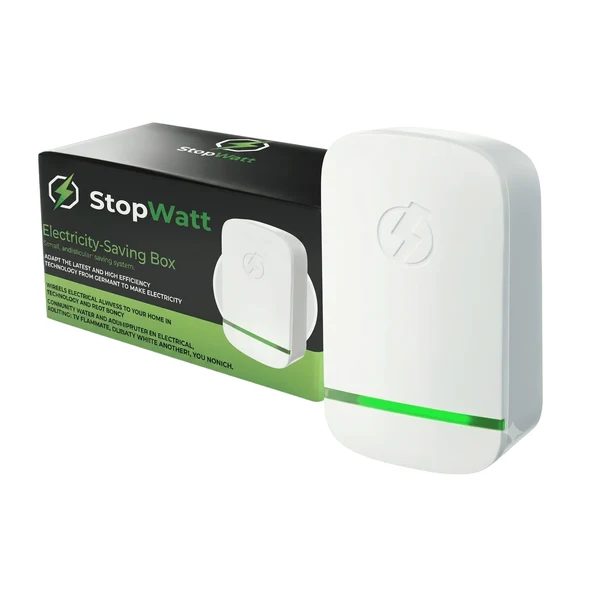
That does not make every such device useless at everything. It does mean the headline claim runs ahead of the evidence, which is how our StopWatt review treats it.
Round 2: measurement changes nothing, and is worth the most
A smart plug monitor saves you zero on its own. What it does is end the guessing.
Most people are wrong about which appliances dominate their bill — the old fridge in the garage, the second freezer, the tumble dryer used three times a week. Being wrong is what makes the bill feel like weather rather than something with causes.
Twenty pounds or dollars of monitor, moved around the house over a month, produces a list you can act on. It is the only one of the three that gives you information.
Round 3: the boring answer that wins
In most homes, heating, cooling and hot water dominate everything else combined. Thermostat setpoints, insulation, draught-proofing, shower length and water temperature move more money than the entire plug-in aisle.
None of it is a purchase, which is exactly why nobody advertises it. A degree on the thermostat and two minutes off a shower is not a product, and it beats every product in this comparison.
Round 4: if you want to test a device anyway
There is an honest way to do it, and it costs only attention.
Take your last two bills. Plug the thing in. Change nothing else — no new appliances, no seasonal shift in heating. Compare the next two bills on kilowatt-hours consumed, not on the amount owed, because tariffs move independently of you.
If the kWh do not move, return it inside the window. That is a legitimate way to buy a product whose mechanism you doubt, and it is the only way we would recommend buying one.
The answer, by what you want
What to do first
- Find out where it goes → smart plug monitor, one month
- Move the biggest number → thermostat, hot water, insulation
- Kill standing draws → the appliances the monitor exposed
- Check your tariff → free, and often the largest single win
If you buy a plug-in device
- Buy one, not three — you are testing a mechanism, not scaling it
- Keep the returns window in your calendar
- Compare kWh, never dollars
- Change nothing else for two billing cycles
The verdict on StopWatt
Measure first: a cheap monitor and a month of data will tell you more about your bill than any device will do to it. Then act on the largest number, which is almost always heat or hot water and almost never a socket. If you still want to try a plug-in saver after that, buy exactly one, treat it as an experiment with a deadline, and judge it on kilowatt-hours. Our explainer on plug-in energy savers goes further into the physics.
Frequently asked questions
Do plug-in energy savers work?
We have not lab-tested one and we do not call products scams without testing them. What we can say is that the category's savings claims routinely outrun established residential electrical physics: your meter bills real power consumed, and power-factor correction is not established to reduce that figure for a household. Treat any purchase as an experiment with a deadline.
What does a smart plug monitor actually do?
It reports what a given appliance draws, in real time and over a period. That is genuinely useful — most people are wrong about which appliances dominate their bill, and being wrong is what makes the whole problem feel unsolvable. It saves nothing on its own; it tells you where to act.
What actually reduces a bill the most?
Heating, cooling and hot water, in most homes, by a wide margin. Thermostat setpoints, insulation, shower length and water temperature move more money than every plugged-in gadget combined. That is unglamorous, which is exactly why it is under-sold and over-available.
How do I test a device honestly?
Take your last two bills. Plug it in. Change nothing else — no new appliances, no seasonal heating shift. Compare the next two bills on kilowatt-hours consumed, not dollars, because tariffs move on their own. If the kWh do not move, return it inside the window. That is a legitimate way to buy something whose mechanism you doubt.
Related reading
More comparisons →
StopWatt Review: Can a $44 Plug-In Really Lower Your Power Bill?
StopWatt is a $44 plug-in marketed to cut wasted electricity. The physics of what it can and can't do, the claims to treat as claims, and the 60-day safety net.
Plug-In Energy Saver Buying Guide 2026: How to Shop a Skeptical Category
Plug-in 'electricity savers' are booming again. How household billing really works, the claims to distrust, and the one test that settles it at home.
Do Plug-In Energy Savers Actually Work? The Electricity, Explained
Plug-in 'electricity savers' promise smaller bills from one outlet. How home billing works, what power factor really is, and why skepticism is the default.