Plug-In Energy Saver Buying Guide 2026: How to Shop a Skeptical Category
Plug-in energy savers are among the most heavily marketed and least substantiated gadgets in e-commerce, and 2026's rising bills have brought the category roaring back. This guide is deliberately protective: how residential billing actually works, the claims that should slow you down, the single before-and-after test that settles the question in your own home, and why the returns window is the only spec that matters.
Published · Facts checked against the official product page
Key takeaways
- Start from how billing works: residential meters charge for real power (kWh consumed). Power-factor and 'dirty electricity' correction — the category's favorite mechanisms — are not established to reduce that number for a household.
- Red flags that should slow any purchase: savings percentages without a measurement method, self-published star ratings, urgency discounts, and any claim that a passive plug can cut consumption of appliances it isn't wired through.
- The one test that settles it: two utility bills before, two after, nothing else changed. Run it inside the returns window and let your meter — not the marketing — deliver the verdict.
- In an unproven category the guarantee is the spec: a real 60-day money-back window (the current benchmark, e.g. StopWatt) is what turns a doubtful purchase into a reversible experiment.
Every time energy prices climb, the plug-in «electricity saver» returns — same promise, new brand names. 2026's bills have brought the category roaring back across US e-commerce, so this guide is deliberately protective: how billing actually works, the claims that should slow you down, and the one test that settles the question in your own home.
Rule 1: understand what your meter charges for
Residential utility meters bill real power — the kilowatt-hours your appliances actually consume. The category's favorite mechanisms (power factor, harmonics, «dirty» electricity) are genuine electrical phenomena, but they're billed to industrial customers under different tariff structures. A household meter simply doesn't charge for the thing a passive outlet plug claims to fix. Any pitch that skips this distinction is selling around the physics. Our energy saver explainer covers the full mechanics.
Rule 2: the red flags
- Savings percentages with no measurement method. «Cut your bill by up to 40%» — measured how, on what home, over what period? Silence is the answer.
- Self-published ratings. A 4.6/5 based on «customer feedback published by the manufacturer» is a marketing asset, not evidence.
- The discount clock. Urgency pricing exists to shorten your thinking. A real product survives a night's sleep.
- Whole-home claims from a single outlet. A passive plug isn't wired through your HVAC, water heater or dryer — the loads that dominate a bill.
Rule 3: the test that settles it
You don't need our verdict — you have a meter. The clean protocol: keep your last two utility bills, install the device, change nothing else, and compare the next two bills. Same season, same habits, same household. If the kWh doesn't move beyond normal variation, the device didn't work in your home, whatever the testimonials say. Run the test inside the returns window and the answer costs you nothing — which is why Rule 4 is the one that decides the purchase.
Rule 4: in this category, the guarantee is the spec
When a category's mechanism is unestablished, the returns policy is your entire protection. The current benchmark is a 60-day money-back window — long enough for two billing cycles — which is what the trending example, StopWatt, declares on its official page. A device without a comparable window doesn't deserve your experiment, whatever its marketing promises.
The short version
Shop plug-in energy savers knowing your meter bills real power and this category isn't established to change it. Distrust percentages without methods and ratings without independence. If you try one, run the two-bills-before, two-bills-after test inside a real 60-day window — and spend an afternoon on the proven levers (thermostat, LEDs, phantom loads, air sealing) that actually move the number.
Frequently asked questions
Do plug-in energy savers really work?
The honest answer: the category's core mechanism is not established to reduce a residential bill. Utility meters bill real power; the power-factor effects these devices address are billed to industrial customers, not households. Individual results people report are usually seasonal variation or coincident behavior change. Shop the category expecting an experiment, not a result.
How can I test an energy saver in my own home?
The clean protocol: keep your last two utility bills, plug the device in, change absolutely nothing else about your usage, and compare the next two bills. Same season, same habits. If the kWh number doesn't move beyond normal variation, you have your answer — run this inside the returns window so the answer is free.
What should I look for before buying one?
In order: a genuine money-back window of at least 30 days (60 is the benchmark), a declared mechanism you can read (even to be skeptical of it), transparent pricing without countdown-clock pressure, and a seller that doesn't claim the device will cut a specific percentage without stating how that was measured.
What actually cuts electricity costs?
Thermostat discipline, LED lighting, phantom-load hunting with a plug-through meter, off-peak scheduling where your utility prices it, and air sealing. Boring, proven, and free-to-cheap — the honest comparison point for any $44 gadget.
Related reading
More buying guides →
Plug-In Energy Device vs Smart Plug Monitor vs Actually Using Less
Three approaches to a high electricity bill. One is measurement, one is behaviour, and one has physics working against it. Which is which.
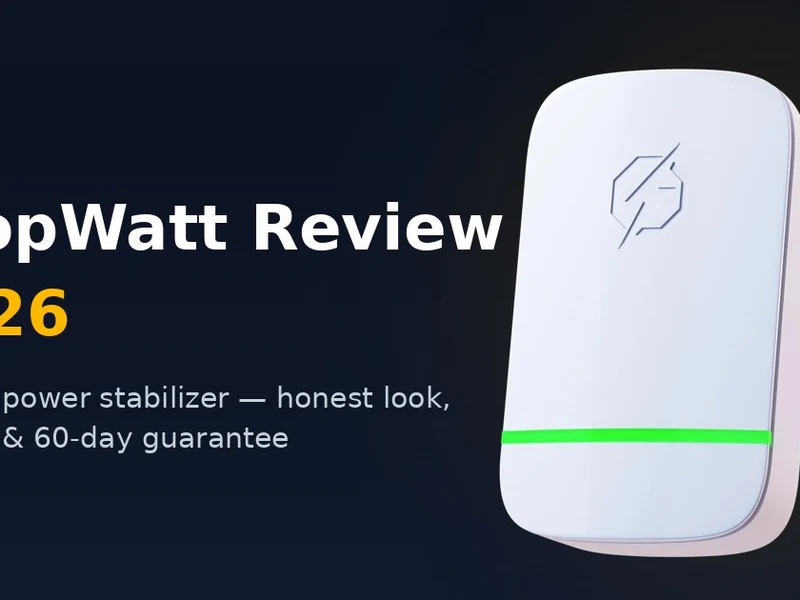
StopWatt Review: Can a $44 Plug-In Really Lower Your Power Bill?
StopWatt is a $44 plug-in marketed to cut wasted electricity. The physics of what it can and can't do, the claims to treat as claims, and the 60-day safety net.
Do Plug-In Energy Savers Actually Work? The Electricity, Explained
Plug-in 'electricity savers' promise smaller bills from one outlet. How home billing works, what power factor really is, and why skepticism is the default.