Where to Place a Carbon Monoxide Detector: A Room-by-Room Guide
A practical placement guide for CO alarms: the floors and rooms that need coverage, mounting height, clearance from appliances, and common placement mistakes.
Published · Facts checked against the official product page
Key takeaways
- Minimum coverage: one CO alarm per floor, including the basement, plus one near (not inside) every sleeping area — CO poisoning during sleep is the scenario alarms exist for.
- CO mixes with room air rather than sinking or strongly rising, so wall-height placement is flexible; near breathing height is a sensible default, and plug-in units at outlet height are acceptable.
- Keep alarms roughly 3–5 meters away from fuel-burning appliances to avoid nuisance readings from normal start-up puffs — but never place them behind furniture or curtains.
- Detectors expire. Sensors degrade after 5–10 years depending on model; check the date and replace on schedule, not on failure.
Why placement is half the product
Carbon monoxide is invisible, odorless and — this is the part that shapes every placement rule — most dangerous while you sleep. A perfectly good alarm in the wrong spot protects the hallway junk drawer, not your family. The good news: the rules are simple and take one afternoon to implement.
The floor-by-floor minimum
Every level of the home gets an alarm, basement included — furnaces and water heaters live down there. Every sleeping area gets coverage: an alarm in the corridor within a few meters of bedroom doors, close enough that the siren wakes people behind a closed door. Larger homes and homes with attached garages add one near the garage-to-house door, because idling engines are a classic CO source.
Height: the myth to unlearn
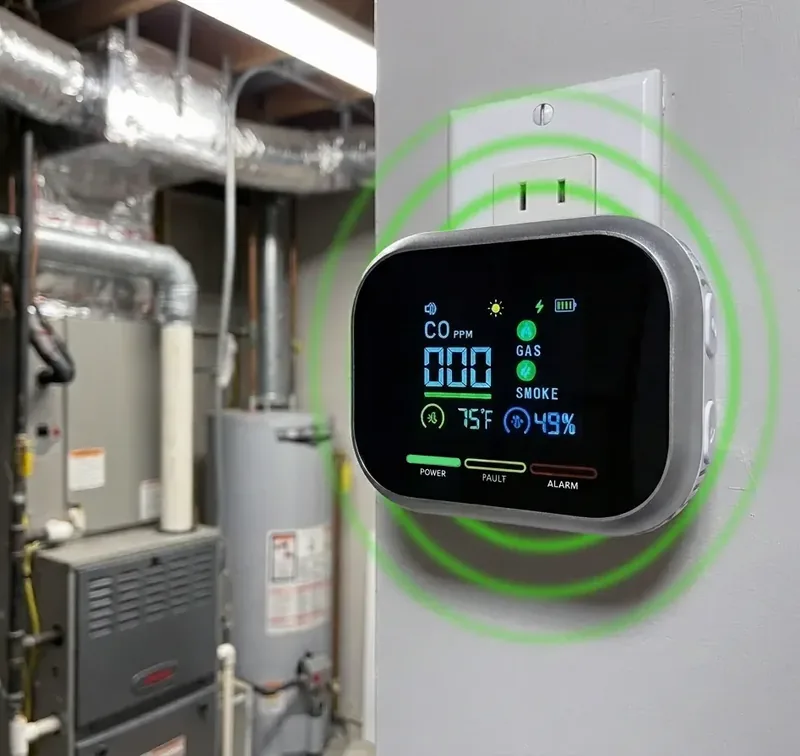
Smoke rises, so smoke alarms go on ceilings — and many people assume CO behaves the same. It doesn't. Carbon monoxide's density is almost identical to air's, so it mixes throughout the room rather than pooling at the ceiling or floor. That makes wall placement around breathing height a sensible default, and it's why plug-in detectors at outlet height, like CarbonOne Safe, are a legitimate format — with the bonus that a live digital display at eye-glance height gets checked far more often than a ceiling puck ever does.
Clearances that prevent false alarms
Keep roughly 3–5 meters between the alarm and any fuel-burning appliance — boilers, gas stoves, fireplaces routinely emit a harmless puff at ignition, and an alarm mounted directly above one will cry wolf until you stop believing it. Also avoid: bathrooms and the steam plume above cookers (humidity kills sensors early), the inside of cupboards or behind curtains (no airflow, no detection), and unheated porches or garages beyond the unit's rated temperature range.
The maintenance rules nobody follows
Test monthly with the button. Vacuum the vents seasonally. And retire the unit on schedule: electrochemical CO sensors wear out in roughly 5–10 years regardless of how the unit looks. Write the install date on the back the day you plug it in. If your current detector predates that window — or if you can't remember buying it — replacement is the correct paranoia. Our CarbonOne Safe review covers what to look for in the current generation of plug-in units, including the one caveat we insist on: a plug-in display unit complements certified ceiling alarms; it doesn't retire them.
Shopping instead of studying? CarbonOne Safe review — our hands-on style coverage of the trending options in this category.
Frequently asked questions
Should a carbon monoxide detector be placed high or low?
CO has nearly the same density as air and disperses evenly, so unlike smoke (high) or LPG (low), height is flexible. Breathing height on a wall is a good default; outlet-height plug-in units are fine, and what matters far more is having one on every floor and near bedrooms.
Where should you NOT put a CO detector?
Directly beside or above fuel-burning appliances (nuisance alarms), inside bathrooms or above cooking steam (humidity and grease), behind curtains or furniture (blocked airflow), in dead-air corners, or in unheated spaces outside the unit's rated temperature range.
Do I need a CO detector if everything in my home is electric?
Risk is lower but not zero: attached garages, portable generators, fireplaces and adjacent apartments are all real CO sources. Most safety bodies still recommend at least one alarm per floor in any enclosed dwelling.
Is a plug-in CO detector as good as a hardwired one?
A certified plug-in unit with battery backup monitors just as well and survives outages — the scenario when generators and alternative heaters come out. The key word is certified: placement advice assumes an alarm built to a recognized standard.
Related reading
More explainers →
Plug-In vs Hardwired vs Battery CO Detector: What Each One Is Actually For
Three mounting formats, three failure modes, and one question that matters more than all of them: is the device certified to a recognised standard?
Carbon Monoxide Detector Buying Guide 2026: The Spec That Isn't Optional
One specification separates a life-safety device from a gadget with a display. Plus where to mount, what expires, and why the test button lies.
Life-Safety Devices Are Being Sold Like Gadgets. The Missing Line Is Certification.
Smoke and CO detectors now sell through the same direct-response funnels as kitchen gadgets — and the standards that define them are dropping off the page.