How Evaporative Air Coolers Work — and When They Don't
The physics behind water-tank air coolers, the honest limits of evaporative cooling, and a simple humidity rule to know whether one will work in your room.
Published · Facts checked against the official product page
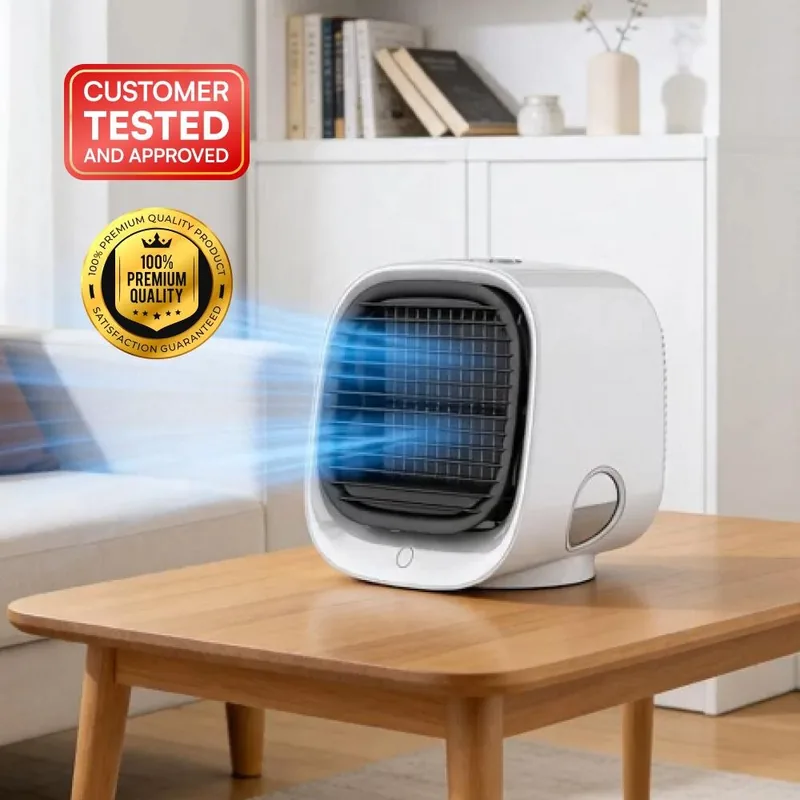
Key takeaways
- Evaporative coolers lower air temperature by turning liquid water into vapor — the phase change absorbs heat, so the air leaving the unit is cooler than the air entering it.
- The drier the air, the bigger the effect. In low humidity a good unit can shave several degrees; above roughly 60–70% relative humidity the effect shrinks toward that of a plain fan.
- They are not air conditioners: there is no refrigerant and no heat is pumped outside. Expect spot cooling for the person in front of the unit, not a chilled room.
- In return, power draw is a fraction of an AC's, there is no compressor noise and no window hose — which is exactly why they trend every heatwave.
The one-sentence physics
Turning liquid water into vapor costs energy, and that energy is taken from the air as heat. An evaporative cooler is just a machine that maximizes this: a fan pulls warm air through a water-soaked pad, some of that water evaporates, and the air comes out the other side cooler and slightly more humid. It is the same reason your skin feels cold when wet — engineered into a box.
That single mechanism explains everything else about these devices: what they can do, what they can't, and why the answer changes with the weather.
What "cooler" actually means in practice
Because the effect works on the airflow rather than the whole room, evaporative units are best understood as spot coolers. Sitting in the air path — at a desk, on a bedside table, next to the sofa — you feel a genuinely cooler breeze. Walk to the other side of the room and the effect fades. That is not a defect; it's the category. The portable units trending this summer, like AiraBreeze in the UK and Germany or the USB-powered Froza AC in France, are explicitly personal devices, and the good ones are honest about it.
How many degrees? It depends almost entirely on humidity, which brings us to the rule that should decide your purchase.
The humidity rule
Evaporation slows down as the air fills with moisture. Practically:
- Dry air (under ~40% relative humidity): best case — the outlet air can be noticeably, usefully cooler than the room.
- Moderate (40–60%): still worthwhile, especially close up, with a smaller temperature drop.
- Humid (above ~60–70%): the physics runs out of room. Expect fan-level relief with a hint of freshness, not real cooling.
Check your local summer humidity before buying. If your evenings routinely sit above 70%, either lower your expectations or pick a unit that is a good fan first — the 2-in-1 designs such as CoolJet and Vital Pro Breeze exist precisely for climates and seasons where evaporation alone can't carry the job.
Cooler vs. air conditioner: the honest comparison
An air conditioner pumps heat out of the room using a refrigerant cycle; the room genuinely gets colder, at the cost of hundreds of watts, a compressor's noise and usually a window hose. An evaporative cooler moves no heat outdoors — it converts a little of it into humidity, right where you sit, for a small fraction of the power. One is climate control; the other is personal relief. Our portable air cooler buying guide walks through the decision step by step, and the air cooler calculator turns your room size, humidity and electricity price into a concrete recommendation.
Getting the most out of one
Three habits separate satisfied owners from disappointed ones. Use genuinely cold water and, where the tank allows, ice — the colder the water, the colder the outlet air. Keep a window cracked so the humidity you're adding leaves the room instead of accumulating. And clean the pad or filter on schedule: a mineral-crusted pad evaporates less water, which is the whole point of the machine.
Shopping instead of studying? AiraBreeze review, CoolJet review, Froza AC review, Vital Pro Breeze review — our hands-on style coverage of the trending options in this category.
Frequently asked questions
Do evaporative air coolers actually work?
Yes, within their physics: they measurably cool the airflow in dry-to-moderate humidity, especially in the direct path of the unit. They do not replace air conditioning in hot, humid conditions.
Do air coolers work in humid weather?
Poorly. Evaporation slows as relative humidity rises, so above roughly 60–70% humidity the cooling effect largely disappears and the unit behaves like a fan. In humid climates a 2-in-1 fan-first unit is the more honest buy.
Do air coolers raise humidity in the room?
Slightly, yes — the water they evaporate ends up in your air. In a small closed room over hours this matters; cracking a window keeps the air exchange going and the effect noticeable.
How much water do portable air coolers use?
Small personal units sip from tanks of a few hundred milliliters to a couple of liters and typically run several hours per fill, depending on fan speed and how dry the air is.
Related reading
More explainers →
Why Portable Cooling Became 2026's Breakout E-Commerce Category
Heatwaves, rental housing and plug-and-play design collided to make portable coolers 2026's defining viral category. The market forces, explained.
Best Portable Air Coolers of 2026: AiraBreeze vs CoolJet vs Froza AC vs Vital Pro Breeze
We compare 2026's four trending portable coolers — AiraBreeze, CoolJet, Froza AC and Vital Pro Breeze — by cooling method, market, guarantee and best use case.

E-Commerce Heat Index — July 2026: The Products Trending Across 4 Markets
TechsTrends' July 2026 Heat Index: demand-signal scores for the trending physical products across US, UK, German and French e-commerce, with charts and open data.