Why Clothes Pill — and Why Shaving Them Actually Works
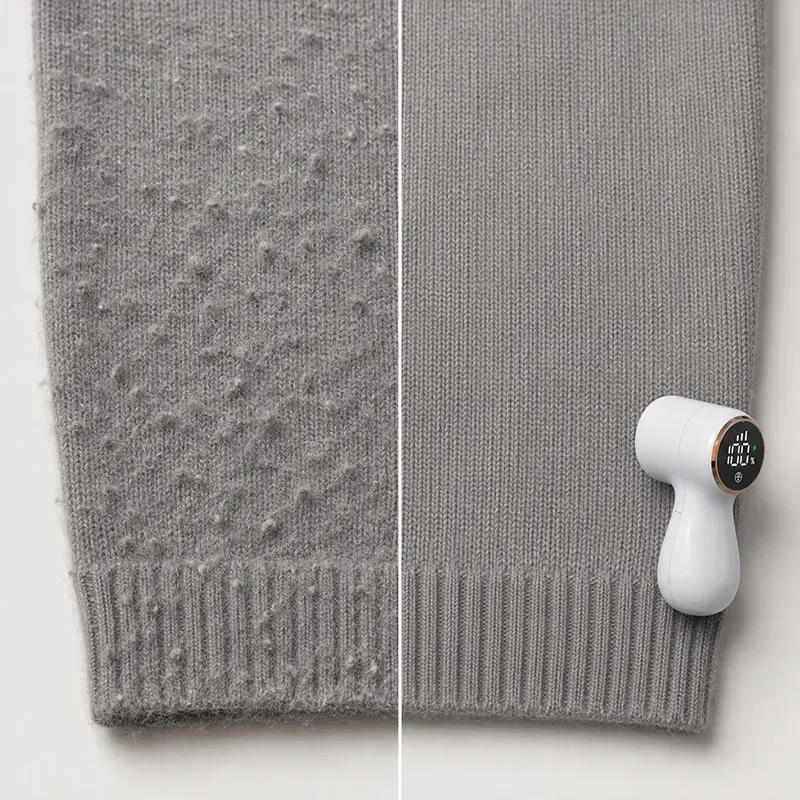
Pilling looks like wear but is really a specific mechanical failure: short fibres work loose, migrate to the surface and tangle into balls that stay attached by fibres strong enough to hold them. Understanding that explains both why cheap wool pills faster than expensive wool and why cutting the pills off is a genuine repair rather than a cosmetic trick.
Published · Facts checked against the official product page
Key takeaways
- A pill is a ball of broken short fibres that migrated to the fabric surface and tangled, held on by longer fibres that did not break.
- Fibre length is the main predictor. Long-staple wool and cotton pill less because there are fewer loose ends to work free; short-staple and blended synthetics pill more.
- Synthetics pill worse than they look like they should — not because they shed more, but because the anchoring fibres are strong enough that the pills never fall off on their own.
- Cutting pills off is a genuine repair, not a cosmetic one: the fibre in a pill has already left the yarn, so removing it restores the surface without costing anything that was still doing work.
A pilled jumper looks worn out, and the instinct is to treat it as an old garment. It is not, quite. Pilling is a specific and fairly narrow failure, and understanding it explains why cutting the pills off is a real repair rather than tidying.
What a pill actually is
Yarn is spun from fibres of finite length. Under friction, the short ones work loose at their ends and migrate to the fabric surface. Once several are out there, they tangle around each other into a small dense ball. What keeps that ball attached is a few longer fibres that did not break — they run from inside the yarn out into the pill and hold it in place.
So a pill is made of fibre that has already left the yarn's structure, tethered by fibre that has not. That asymmetry is the whole story of this category.
Why some fabrics pill and others barely do
Fibre length is the main predictor. Long-staple cotton and merino have fewer loose ends per centimetre of yarn, so there is less to work free. Short-staple fibres and heavily blended yarns have more. This is why a fine gauge lambswool can pill faster than a coarse one — it is not about thickness, it is about what the yarn was spun from.
Synthetics are the interesting case. Polyester and nylon do not shed more than wool; they shed about the same. What differs is what happens next. Wool's anchoring fibres are relatively weak, so a wool pill often breaks off on its own during the next wash. A polyester anchoring fibre is strong enough that the pill simply never leaves. That is why synthetic and blended garments look worse over time than their shedding rate would suggest, and why a wool-synthetic blend can pill more visibly than either fibre alone.
Friction decides where, not whether
Pills appear where fabric rubs against something: under the arms, on the inside of sleeves, along a seatbelt line, under a bag strap, on the arms and seat of a sofa. A garment worn loosely pills later than the same garment worn tight, and a sofa nobody sits on stays smooth for years. Nothing about this is a manufacturing fault — it is the fabric doing what fabric does under repeated abrasion.
Why cutting them off is a genuine repair
Here is the part that matters. Because a pill is made of fibre that has already left the yarn, removing it costs the garment nothing that was still doing structural work. Cutting the pill off leaves the fabric with exactly the strength it had five seconds earlier, minus a ball of tangle that was contributing nothing.
That is why fabric shavers work in a way that most restoration gadgets do not. They are not putting anything back or reversing anything — they are removing debris that was already detached. The garment ends up marginally thinner than when it was new, because the fibre in those pills is gone either way, but no thinner than it was before the shave.
The one way to make things worse is a blunt blade. A sharp edge severs the anchoring fibres cleanly at the surface. A dull one catches them and pulls, which drags on fibre that is still inside the yarn and starts the next pill. That is the entire argument for taking blade condition seriously, and it is unpacked further in our NoFuzz review.
Slowing it down
Wash knitwear inside out, on a gentle cycle, in a mesh bag if you have one — all three reduce the abrasion that starts the process. Avoid tumble drying anything that pills, since a dryer is a machine for making fabric rub against fabric. And accept the first round: almost every knit sheds its weakest fibres early, then settles. A garment that pills once and stops is behaving normally.
Frequently asked questions
Does pilling mean the garment is low quality?
Not on its own. It means the yarn contains short fibres with loose ends, which correlates with cost but is not the same as it. A cheap long-staple cotton pills less than an expensive short-staple wool. Where quality does show is in how quickly it starts and whether it stops — a garment that pills once and then settles is normal; one that keeps producing pills after every wear is shedding structure.
Why does the same jumper pill in one place and not others?
Friction. Pills appear where fabric rubs — under the arms, along a seatbelt line, where a bag strap sits, on the inside of sleeves. That is why underarms and cuffs go first, and it is also why a sofa pills on the arms and the seat and nowhere else.
Will the pills come back after shaving?
Some, and then fewer. Shaving removes the fibres that had already broken free, and the ones remaining underneath are the ones that survived the friction so far. Most garments need one thorough pass and then occasional touch-ups, rather than the same job repeated at the same intensity.
Related reading
More explainers →
NoFuzz Review: the Fabric Shaver That Buys Your Knitwear Another Winter
NoFuzz is a rechargeable fabric shaver with three speeds and an LCD, at $49.95. The mechanism is real — here's what the page never publishes about it.
Fabric Shaver Buying Guide 2026: How to Revive Knitwear Without Wrecking It
How to choose a fabric shaver: blade guards, speed control, blade replacement and the specs that decide whether a jumper survives. The category, explained.
Restore-Don't-Replace Is the Quiet Growth Story in US Home Gadgets
Fabric shavers, steamers and repair tools are climbing US e-commerce as replacement costs rise. The forces behind the restore-don't-replace wave.