Shoulder Wrap vs Massage Gun vs Heat Pad: Which One Your Shoulder Wants
A wearable wrap, a percussion gun and a plain heat pad solve overlapping problems in different ways and fail differently too. This comparison decides between them by symptom rather than by score — including the case where the honest answer is the cheapest of the three.
Published · Facts checked against the official product page
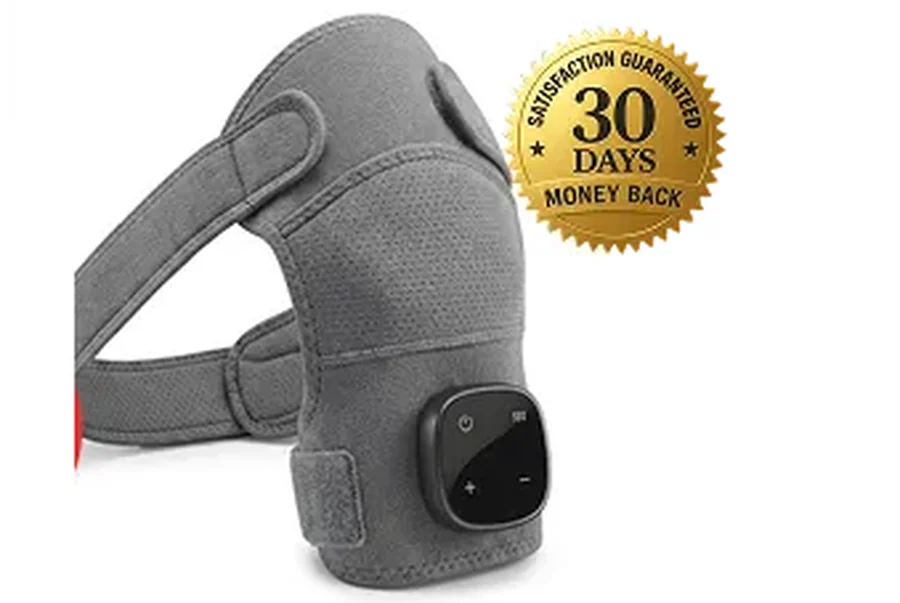
Key takeaways
- Wearable wrap: the only one of the three you can use hands-free, and the only one that reaches the joint itself rather than the muscle around it.
- Massage gun: the most powerful, aimed at muscle bulk, and the easiest to overdo on an already irritated joint. Handheld, which on your own shoulder is awkward.
- Heat pad: cheapest by a wide margin, does one thing properly, and beats both for pure morning stiffness. No battery, no motor, nothing to break.
- For a genuinely sore joint the wrap wins on ergonomics; for tight muscle around the shoulder blade the gun wins; for stiffness alone, the pad is the honest answer.
Three tools, three different jobs, and a lot of overlap in the marketing. Choosing between them is easier than it looks once you decide what your shoulder is actually doing.
Round 1: what each one reaches
A wearable wrap sits on the joint and delivers warmth and compression to it directly. A massage gun delivers impact to muscle bulk — excellent around the shoulder blade, largely wasted on the joint capsule, which has almost no muscle over it. A heat pad warms whatever it's draped on, joint or muscle, without discriminating.
If the pain is in the shoulder, the wrap reaches it and the gun mostly doesn't.
Round 2: ergonomics, which decides usage
This is where the wrap wins decisively, and it matters more than any spec. A shoulder is the one joint you cannot comfortably work on with your own hand on the same side. A gun requires the opposite arm at an awkward angle for the whole session; a pad requires staying still and holding position.
A wrap you strap on and forget for twelve minutes while doing something else. The device you actually use twice a day beats the more powerful one you use twice a week.
Round 3: what it costs
A heat pad is a fraction of the price of either powered option and has nothing to fail — no battery, no motor, no charge cycle. A wrap sits in the middle. A decent massage gun costs more than both and is the most likely to be an impulse purchase that ends up in a cupboard.
Worth saying plainly: if your complaint is morning stiffness that eases once you move, the pad does the useful part of what the expensive options do. That is the honest recommendation for a meaningful share of people who arrive at this category.
Round 4: how each one fails
The pad fails by doing only one thing. The wrap fails on fit — if it doesn't sit on the joint it compresses nothing and heats the wrong place. The gun fails by being too much: percussion on an already inflamed shoulder can cost you a day, and it's the only one of the three that can make things actively worse.
The answer, by symptom
Reach for the wrap
- Pain in the joint itself rather than the surrounding muscle
- A shoulder that feels unstable or fatigued from holding a position
- Anything you want to treat while working or before sleep
- When you'll only stick with something that needs no hands
Reach for something else
- Tight muscle around the shoulder blade → massage gun
- Pure morning stiffness that eases with movement → heat pad
- An acutely inflamed, hot shoulder → none of the three, yet
- Night pain, weakness or numbness → a clinician, first
The verdict on Vital Shoulder Massager
For a sore shoulder joint that you want to treat consistently without holding anything, the wearable wrap is the format that gets used — and getting used is most of what makes any of these work. Our current example is the Vital Shoulder Massager, where the hardware is reasonable and the page selling it needs reading slowly. But do the honest check first: if the answer is «stiff in the morning, fine by ten», buy the heat pad and keep the difference.
Frequently asked questions
Can I just use a heat pad?
Often, yes — and it's the answer we'd give more people than sellers would like. If the complaint is morning stiffness that eases with movement, a heat pad does the useful part of what a A$77 wrap does, for a fraction of the price, with no battery and nothing to fail. What it can't do is compress, vibrate, or stay on while you work.
Is a massage gun bad for shoulders?
Not bad — mismatched, usually. Percussion is designed for muscle bulk, and the shoulder joint has very little of it. Around the shoulder blade, where the muscle is, a gun is genuinely useful. On the joint itself it's too much input in too small an area, and on an inflamed shoulder it can make things worse for a day.
Which is best for sleeping?
None of them while asleep — don't sleep on a heated device. Before sleep, a wrap or a pad both help; the wrap has the edge because compression reduces the fidgeting that comes from a shoulder that feels unstable when you lie on it.
What if none of them helps?
Then the question was never which device. Pain that doesn't respond to heat, rest and time over six weeks, or that wakes you at night or comes with weakness, needs identifying rather than treating. That's a clinician, not a purchase.
Related reading
More comparisons →
Vital Shoulder Massager Review: Real Comfort, and an Advertorial That Overreaches
Heat, compression and vibration in a strap-on wrap, from A$54.44. The mechanisms are real; the page that sells them is not a news article. What to check first.

Shoulder Massager Buying Guide 2026: What to Check Before You Strap Anything On
Heat, compression, vibration and percussion do different jobs. How to match the format to your shoulder — and the specs sellers in this category keep quiet.
Why Heat, Compression and Vibration Make a Sore Joint Feel Better
Three mechanisms behind almost every wearable pain device — what each one does in the tissue, why relief is temporary, and where the marketing overreaches.