Do Personal Desk Air Coolers Actually Work? The Physics, Honestly
The personal cooler's promise sounds too good — cold air in minutes from a device that fits in one hand. The honest answer is that it works on you without working on the room: a walkthrough of moving-air physics, evaporative assists, the up-to-8°C claim and the questions that actually decide whether one will help.
Published · Facts checked against the official product page
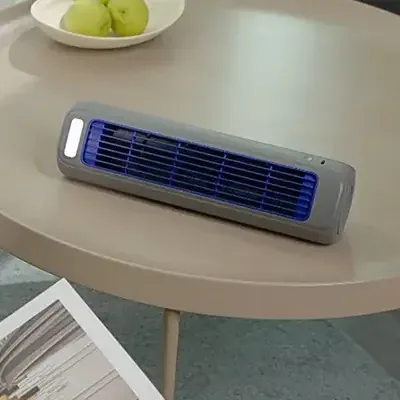
Key takeaways
- Personal coolers work on you, not on the room: moving air accelerates the body's own evaporative cooling, which is why a breeze feels several degrees cooler than still air at the same temperature.
- Claims like 'air up to 8°C cooler' describe the outlet air in the personal zone under favourable conditions — a real, measurable effect that nonetheless leaves the room's thermometer unmoved.
- The format's genuine advantages are economic and practical: USB-level power draw, zero installation, and placement exactly where cooling is felt — the desk, the bedside, the rented flat.
- Judge any personal cooler by three questions: how close it sits to you, how loud it is at your real working speed, and whether the seller frames it as personal cooling (credible) or room cooling (walk away).
The pitch sounds like a physics violation: cold air in minutes, from a device that weighs half a kilogram and runs off USB power. The truthful answer to «does it work?» is more interesting than yes or no — it works on you without working on the room, and understanding why tells you exactly whether one will help your summer.
The half your body does
Your skin is an evaporative cooler. In still air, you sit inside a self-made blanket of warm, humid air that throttles that evaporation. Moving air strips the blanket away, and perceived temperature drops by several degrees with no change on any thermometer — the effect meteorologists fold into «feels like» readings. Every fan exploits it; personal coolers concentrate it, aiming a focused stream exactly at desk-and-face height, from close range, where the effect per watt is greatest.
The half the device does
Better personal coolers add a second stage: cooling the outlet air itself, typically with an evaporative element or chilled medium. That's the layer behind claims like the current UK trend leader's «air up to 8°C cooler» — a description of the outlet stream in the personal zone under favourable conditions. It's a real, measurable effect, and it obeys the evaporative rule we detail in the evaporative cooling explainer: the drier the ambient air, the stronger the cooling. What it never does is export heat from the room — that thermodynamic job belongs to refrigerant air conditioning, which is precisely why the honest comparison is «without a £400 unit», not «equal to one».
So who genuinely benefits?
The format earns its keep where cooling needs to be personal, placeless and cheap to run: the home-office desk that hits 30°C by noon, the bedside in a rented flat where installation is impossible, the caravan or garden table beyond any AC's reach. USB-level power draw means it runs from a laptop or power bank, and the newest UK-market formats add no-drill wall mounting for renters. The buyer it disappoints is the one expecting a room to cool down — a job description this category never honestly claimed. Our personal cooler buying guide turns these lines into a checklist, and the Froza review applies them to the unit currently trending in the UK and France.
Frequently asked questions
How can a tiny cooler make air feel 8°C cooler?
Two effects stack. Moving air strips away the warm, humid layer your body builds around itself, accelerating your own evaporative cooling — a breeze genuinely feels several degrees cooler than still air. Devices that add an evaporative or chilled element cool the outlet air itself on top. The result is a real personal-zone effect; the claim describes that zone, not the room.
Will a desk cooler lower my room's temperature?
No — and this is the honest line of the whole category. Reducing a room's temperature requires moving heat out of it, which is refrigerant air conditioning's job. A personal cooler redistributes and accelerates air in your immediate zone; the thermometer on the wall won't move.
Is a personal cooler worth it if I already have a fan?
A fan does the moving-air half of the job well. The personal-cooler tier adds directionality at desk height, USB portability, and in some designs an evaporative or chilled-outlet assist — plus formats like no-drill wall mounting. If your fan already sits at face height on your desk, the upgrade is incremental; if your cooling lives across the room, the difference is real.
Related reading
More explainers →
How Evaporative Air Coolers Work — and When They Don't
Evaporative air coolers drop the temperature with water, not refrigerant. How the physics works, real cooling limits, and the humidity rule that decides everything.
Froza Lands in the UK: France's Viral Personal Cooler Goes British
Froza, the personal cooler behind France's canicule spikes, now has an official UK page — 30-day guarantee, 48-hour dispatch and a no-drill wall mount.
Personal & Desk Air Cooler Buying Guide 2026: Small Coolers, Honest Expectations
USB desk coolers promise cool air in minutes for a fraction of an AC's price. What the small format genuinely does, what it can't, and the pre-buy checklist.